

Top 8 Cities to Start a Food Truck in 2026 [A Research-Driven Guide for the Next Generation of Mobile Food Entrepreneurs]

The U.S. food-truck industry is entering its most opportunity-rich decade yet. Operators aren’t just slinging tacos and burgers — they’re building brands, testing restaurant concepts, and growing multi-truck “micro-chains” with loyal followings and strong unit economics.
In 2026, the winners will be the trucks that choose cities strategically, not emotionally.
Why? Because your city determines your:
- Regulatory friction (permits, restrictions, enforcement)
- Customer density (tourists, office workers, students, nightlife)
- Operating days (weather + foot traffic patterns)
- Competition level (ecosystem maturity)
- Scalability (ability to run more than one truck or daily shifts)
Based on nationwide data, local permitting requirements, operator experiences, and macro-industry analysis, here are the Top 8 Cities to Start a Food Truck in 2026, each backed with operational reasoning.
How We Evaluate a Food-Truck Market
We score cities based on five weighted criteria:
- Permit Burden & Regulatory Predictability
- Demand Density & Revenue Drivers
- Weather & Year-Round Operating Days
- Competition & Ecosystem Maturity
- Scalability & Growth Potential
A great food-truck city is not just “friendly” — it must be high-demand, navigable, and profitable.
Let’s break down the top performers for 2026.
1. Portland, Oregon — The Gold Standard of Food-Truck Cities
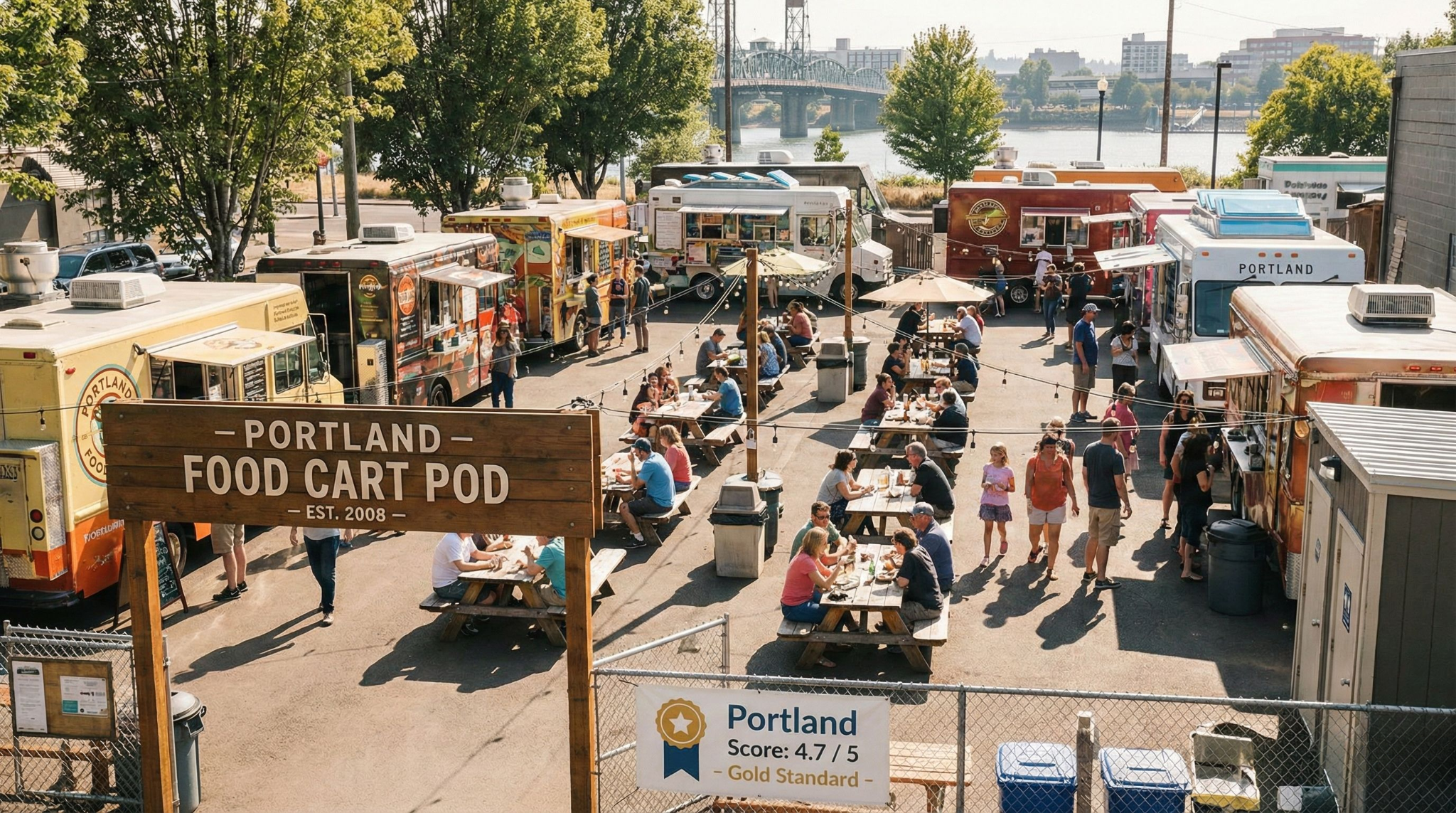
Score: 4.7 / 5
Portland remains the most structurally advantageous city for food trucks. The “food cart pod” model (clusters of trucks on private lots) is unmatched anywhere else in the U.S. This model:
- Reduces zoning headaches
- Provides shared amenities (power, water, restrooms)
- Guarantees daily foot traffic
- Makes newcomer entry far easier
Permits are straightforward, health inspections are predictable, and food carts are part of Portland’s cultural identity.
Best For:
Operators building multi-cart brands, niche cuisine concepts, or trucks wanting reliable daily volume.
2. Denver, Colorado — The High-Growth, Low-Drama Market
Score: 4.3 / 5
Denver is the perfect mix of:
- Growing population + affluent millennials
- Strong lunch and weekend demand
- Balanced, clear permitting
- Flexible vending spaces (breweries, markets, office districts)
Unlike the coasts, Denver keeps its regulatory load reasonable and its commissary/inspection processes manageable. Trucks offering healthier, premium, or ingredient-forward menus thrive here.
Best For:
Concepts that want stability, a health-conscious customer base, and operator-friendly permit processes.
3. Orlando, Florida — High Tourism + High Food-Truck Volume
Score: 4.1 / 5
Orlando has one of the highest food-truck counts per capita and one of the most active event ecosystems in the country:
- Theme parks
- Conferences
- Conventions
- Festivals
- Tourism corridors
- Breweries and nightlife
What makes Orlando strong is not just tourism — it’s the year-round operating days and the city’s willingness to support mobile vendors as part of its hospitality engine.
Best For:
Operators comfortable with events, catering, families, and multi-location weekly rotations.
4. Austin, Texas — High Upside, High Competition
Score: 4.3 / 5
Austin is the food truck capital of the U.S. by cultural reputation and density.
But Austin is not “easy.”
It is competitive, crowded, and demanding, but equally high reward:
- SXSW
- ACL
- UT campus
- Tech offices
- Rainey Street / East Austin
- Massive weekend markets
- Brewery parks
- Late-night scenes
Permits are reasonable and predictable, and private food truck parks simplify operations. However, execution must be top-tier.
Best For:
Founders who are confident in their branding, operations, speed, and consistency.
5. Philadelphia, Pennsylvania — High Earnings, High Paperwork
Score: 3.7 / 5
Philadelphia is deceptively strong for food trucks despite:
- Higher permit costs
- Strict parking and zoning rules
- A multi-layered compliance structure
Why? Because the demand density is massive:
- Universities (Drexel, UPenn, Temple)
- Hospitals
- Office corridors
- Tourism
- Sports complexes
Food trucks in Philly can earn extremely well if they navigate the permit maze. It’s a city where discipline = profitability.
Best For:
Operators who want big-city volume and can stay organized through a more complex compliance landscape.
6. San Diego, California — High Foot Traffic, High Compliance Load
Score: 3.6 / 5
San Diego offers a rare trio:
- Incredible weather
- Constant tourism
- Beach + brewery culture
Demand is consistent throughout the year, especially near:
- Pacific Beach
- Gaslamp Quarter
- Balboa Park
- La Jolla
- Mission Bay
- Military bases
But California’s statewide rules mean:
- Mandatory commissary requirements
- Multi-stage health permitting
- Parking + zoning restrictions
It’s a high-opportunity market — but paperwork-heavy.
Best For:
Operators capable of managing compliance while tapping into outdoor coastal crowds.
7. New Orleans, Louisiana — Festival-Driven, Weather-Volatile
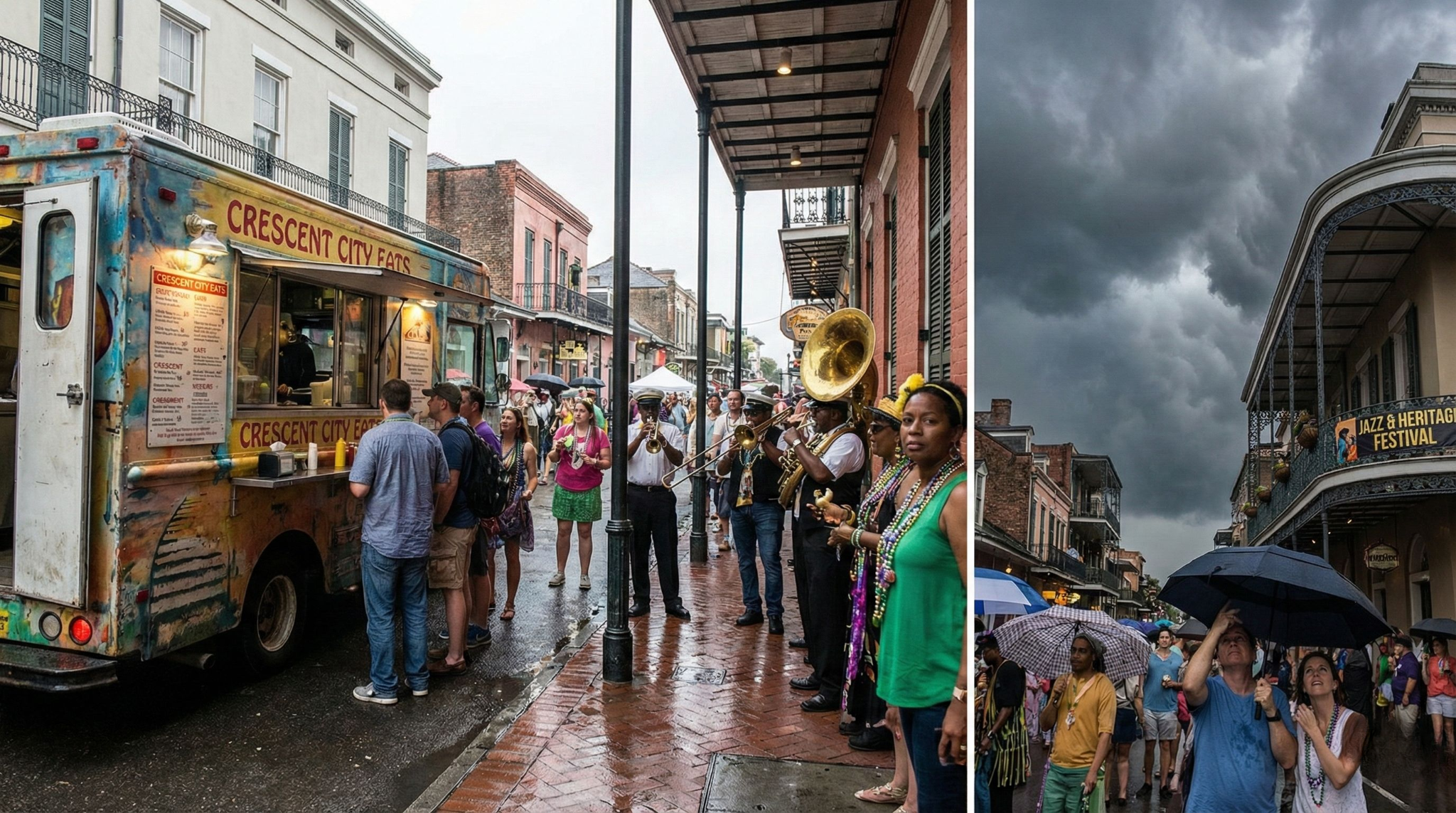
Score: 3.5 / 5
New Orleans is unique. Revenue is not evenly distributed — it’s concentrated in massive spikes:
- Mardi Gras
- Jazz Fest
- Essence Fest
- Saints games
- French Quarter events
Trucks that align with the festival calendar can earn extraordinary revenue. Between major events, steady business is possible but requires venue partnerships.
Weather is the wildcard: heat, humidity, sudden storms, and hurricane patterns make consistency a challenge.
Best For:
Operators who excel at logistics, festival planning, and high-volume service windows.
8. Indianapolis, Indiana — Underrated, Low-Cost, Growing
Score: 3.8 / 5
Indy is rarely hyped on social media — but the numbers tell a different story.
Its strengths include:
- Low operating and permit costs
- Healthy event + office + suburban demand
- A growing downtown
- Less competition than coastal metros
- Easy compliance processes
This is a city where operators can enter cheaply, validate their concept, and expand into a multi-city Midwest route (Indy → Louisville → Cincinnati → Columbus).
Best For:
First-time operators or trucks expanding into a stable, scalable Midwest region.
2026 Food-Truck Friendliness Table (All 8 Cities)
Where the Food-Truck Industry Is Heading (2026–2030)
The next five years will reshape the food-truck landscape far more than the last fifteen. This is no longer a novelty-driven segment — it’s becoming a national, multi-billion-dollar mobile restaurant category with real operational standards, investor attention, and technology adoption.
Here’s what the next era will look like:
1. Expansion of Food-Truck Parks & Pods — Especially in Mid-Sized Cities
Cities like Columbus, Charlotte, Nashville, Tampa, and Phoenix are already developing Portland-style pods with shared utilities, curated vendor mixes, and consistent foot traffic. By 2030, food-truck parks will become anchor assets in suburban and mixed-use developments — not just “empty lot” pop-ups.
2. Surge in Digital Ordering at Breweries, Markets & Events
The brewery + food-truck partnership model is exploding. Combined with QR ordering, line-busting handhelds, and mobile kiosks, ordering will shift from slow walk-up windows to distributed, frictionless digital flows. This directly increases throughput and ticket size — which means operators who adopt ordering tech will win more brewery and venue contracts.
3. Intensifying Competition in Tourism-Heavy Markets
Cities like Austin, Orlando, San Diego, and New Orleans will see a flood of new trucks chasing tourism spikes. The winners won’t be “the newest”; they will be the trucks with better branding, better ops, and better customer flow design. These markets are shifting from “creative concepts win” to “creative concepts that execute flawlessly win.”
4. Rising Labor Costs → Operational Efficiency Becomes a Survival Metric
Labor shortages and rising wages will force food-truck operators to rethink workflows. Trucks running with 2–3 staff will need POS-driven speed, automated upsells, faster prep stations, and optimized menu engineering. In this environment, technology becomes a productivity multiplier, not a luxury.
5. Weather Volatility Will Force Equipment & Tech Upgrades
Heat waves, sudden storms, unpredictable festival weather, and extreme humidity will push operators toward rugged hardware, better offline reliability, and more flexible service models. Trucks that can’t handle weather disruptions will lose prime events — or worse, lose inventory.
6. Multi-Truck Micro-Fleets Will Become the New Norm
The era of the “single truck operator” is fading. The most profitable businesses will be two-to-five truck micro-fleets that rotate between pods, breweries, events, corporate catering, and festivals. This requires back-office control, menu standardization, multi-location analytics, and a POS that can scale without breaking.
The Bottom Line
The next generation of food-truck winners will operate less like hobbyists and more like mobile fast-casual brands.
Execution — not concept — becomes the differentiator.
- Marketing that builds loyal followings
- Operations designed for peak efficiency
- Ordering tech that eliminates friction
- Prep workflows that support higher volume
- Menu engineering that protects margin


Sahana is a seasoned GTM leader with a passion for building startups. She excels in crafting GTM strategies for tech products, driving revenue growth.